How We Built Egypt's First Bookable Marketplace for Mobile LED Advertising
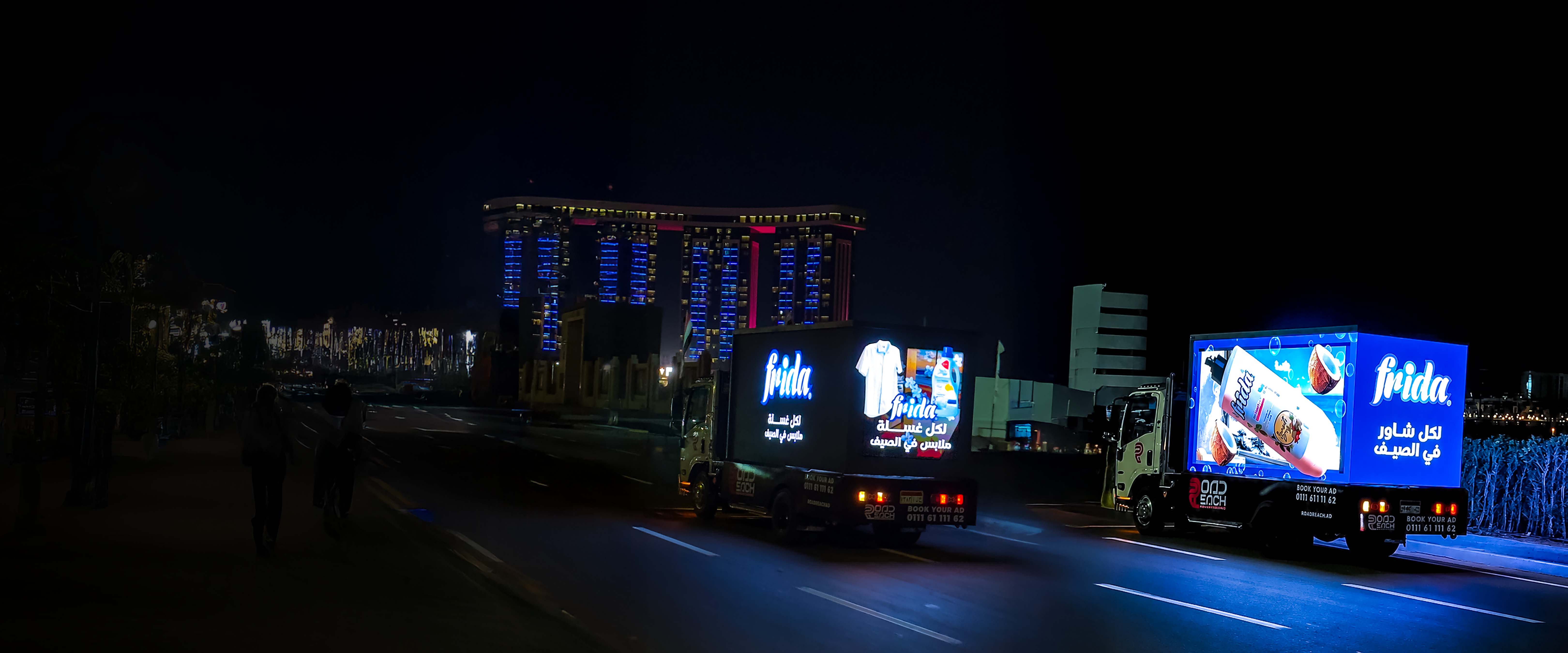
Quick answer: Through its Road Reach project, Blue Agency built the first system in Egypt that turns booking a mobile LED ad from a negotiation into an online marketplace: live calendar availability, real-time pricing, deposit confirmation, instant emailed invoices, and agency discount codes, plus GPS and livestream proof that the campaign actually ran.
The market we started from
Egypt's outdoor advertising market is large and active, but it still runs manually:
- Availability is private. Nobody knows whether a space is free until they ask.
- Pricing is negotiated. The same space carries two prices depending on who's asking.
- Booking is slow. From enquiry to confirmation can take days.
- Proof is weak. A photo or two at the end of the campaign.
- Flexibility is low. Mostly monthly contracts, no single-day option.
We concluded these aren't operational problems: they're structural ones. And the fix isn't a faster salesperson. The fix is a system.
The decision: build a marketplace, not a "request a quote" page
The easy path was a "request a quote" form. But that would have reproduced the same problem in nicer packaging.
So we built the harder thing: real inventory, listed online, with real availability, at a real price, with a real confirmation.
To make that possible we treated the moving screen as schedulable inventory: exactly like airline seats or hotel rooms:
- The base unit is a day.
- On a Loop, a day is divided into a limited number of slots.
- On Exclusive, a day is a single unit for a single advertiser.
- Every day carries a status: Available · Limited · Booked · Unavailable.
That simple model is the foundation of the whole system.
How we built it: six deliberate steps
The flow runs in six steps, and each one was designed to solve a specific market failure:
| Step | The problem it solves |
|---|---|
| 1 – Campaign type (Loop / Exclusive) | Reduces a complex decision to two clear options |
| 2 – Route (North Coast / Zayed & October) | Ties budget to audience instead of scattered "sites" |
| 3 – Dates (live availability calendar) | Ends private availability and late "that's booked" news |
| 4 – Summary + agency coupon | Transparent pricing, partner rates without negotiation |
| 5 – Details (company/agency/individual + tax number) | Clean documentation from day one |
| 6 – Deposit | Converts intent into a locked booking instead of waiting on approvals |
All of it is tied to operations: live GPS, client livestream and a performance report, so transparency isn't limited to buying, it extends into delivery.
Hard decisions we made
1. Show availability to everyone.Exposing inventory exposes you: the client sees which days are taken and which are free. We chose transparency because it's the fastest route to trust in a market built on opacity.
2. Allow single-day bookings.Operationally difficult, but it opened the market to segments that previously couldn't advertise at all: a small branch opening, a one-day offer, a local event.
3. Put agency coupons inside the system.Instead of renegotiating every booking, an agency gets a code that recognises it and applies its rate automatically: the first step in turning partnerships into an operational relationship rather than a series of phone calls. Read the details.
4. Make proof part of the product, not an add-on.Livestream and GPS aren't extras: they sit at the centre of the offer, because the market's hardest question is: *how do I know?*
The assets behind the system
This isn't only software: there's real operation underneath it:
- Three synchronized LED screens totalling 20 m².
- 10 hours of daily operation in prime time (3PM – 1AM).
- Two routes: the North Coast (Marina → Amwaj via Hacienda, Marassi and Sidi Abdel Rahman) and Sheikh Zayed & 6 October.
- Tracking and streaming hardware on the vehicle.
- A design team preparing creative for the screen.
The first real proof on the ground came with Frida (by Fridal), which ran its summer campaign along the North Coast for 10 days, 10 hours a day, using a 3D creative that generated organic social media responses.
Why this matters for Egypt's advertising market
When a medium becomes a bookable product, three things happen:
- New segments enter. Small and mid-sized businesses previously priced out of OOH can now test with a single day.
- Agencies get more efficient. Less time on coordination, more on strategy and creative.
- A standard starts to form. Once proof is available, it becomes much harder for anyone to sell promises.
We believe that's the direction the whole market moves over the next few years, and we're moving early.
What's next
We keep developing the system: more routes, deeper tracking tools, and an easier experience for agencies and their clients.
Frequently asked questions
Who built the Road Reach system?Blue Agency, an Egyptian advertising agency, developed it as part of the Road Reach Advertising project.
Is this the first system of its kind in Egypt?It is the first in Egypt to allow a mobile LED advertising campaign to be booked fully online, with live availability, deposit confirmation and an instant invoice.
How is it different from other advertising websites?Most sites take an enquiry. Here you see availability and price and confirm the booking in the same session, then track delivery via GPS and livestream.
Is the system available to agencies?Yes, and there's a dedicated discount-code programme for agencies with a cooperation agreement.
Are new routes coming?The system keeps expanding; the currently available routes always appear at the route selection step on the booking page.
*Blue Agency · info@blueagency-eg.com · +2 01101011396 · +2 01116111162 · @roadreachad*